
The formwork for the transfer slab at level 2 is checked and the reinforcement is fixed. The consultant's inspector arrives for the pre-pour inspection, opens the drawing and stops. The riser opening has moved 600 mm and two beams are deeper. The site team built to revision C. Revision D was issued three weeks ago. It went to the document controller, to the planner and to the subcontractor's office. It never reached the foreman's folder in the site cabin.
Nobody hid anything. The new revision arrived. The old one was simply never taken out of use.
What it costs
Work built to a superseded drawing is usually the contractor's cost to put right, and it is hard to argue otherwise: the revision was issued and the transmittal was received. The direct cost is the rework. The larger cost is time. The pour is lost, the following trades wait, and an NCR stays on the project's record.
Stripping and re-fixing the reinforcement in one transfer slab bay takes a gang of eight four days, with materials and crane time: about AED 45,000. The pour slips a week, and the floor above slips with it. Because revision D was properly issued, little of this is likely to be recovered from the owner.
How it is usually handled
- Drawings arrive as email attachments and are saved to a shared drive under names like "Final_revD_updated".
- Printed sets on site are not withdrawn when a new revision arrives.
- Subcontractors keep their own copies, sent to them at different times by different people.
- The drawing register is a spreadsheet that shows what was received, not what is actually in use on site.
The weak point is not the issue of the new revision. It is everything that has to happen after it, by hand, in several places at once.
How Quanto Management handles it
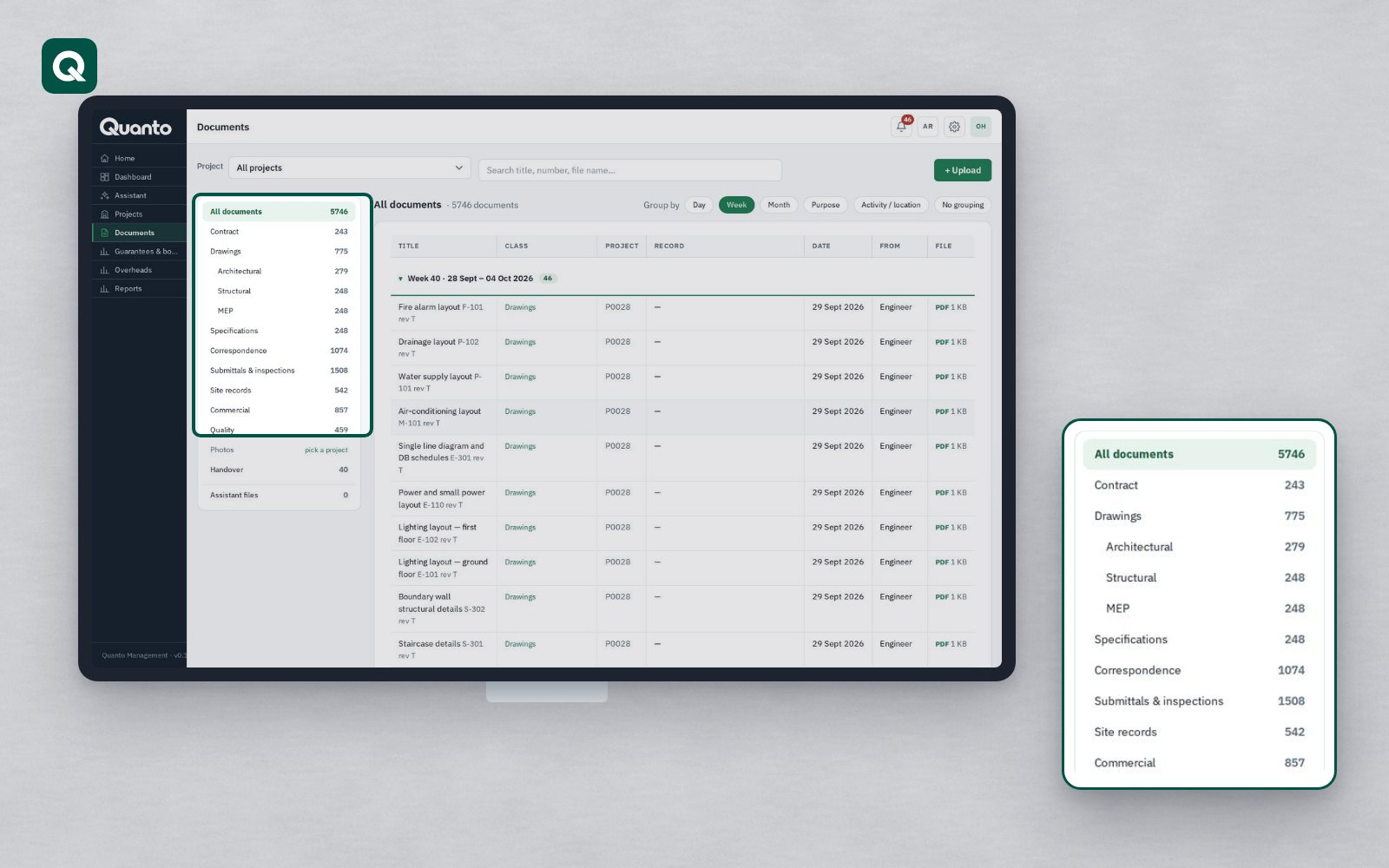
Quanto keeps a documents library for each project, by class of document. Each drawing carries its revisions and their status: for approval, for construction, as built or superseded.
- Current and superseded revisions are clearly marked, so an old drawing does not look like a live one.
- The built-in viewer opens drawings with no download, and Quanto works in the browser on phones and tablets, so the site can work from the library instead of from saved copies.
- Transmittals in and out are recorded in the registers, so you can show what was sent, to whom and when.
- Shop drawings carry their own revisions, review codes (A to D), ball in court and due dates.
- Inspection requests carry the drawing they are inspected against, so the revision is checked when the request is raised, not when the inspector arrives.
Subcontractors invited to the project work from the same library for their own part, so they are not building from a copy someone forwarded to them weeks ago.
A short checklist
- Keep one drawing register for the project, and make it the only source.
- When a new revision arrives, withdraw or stamp the old prints on site the same day.
- Check the revision on the drawing before every inspection request and every pour.
- Issue each new revision to subcontractors by transmittal, and record who received it.
- Read the revision clouds and notes, not only the revision letter.
Tomorrow: retention that never gets released.
Follow Quanto for a new article every day: LinkedIn · X · YouTube · Instagram · Facebook