
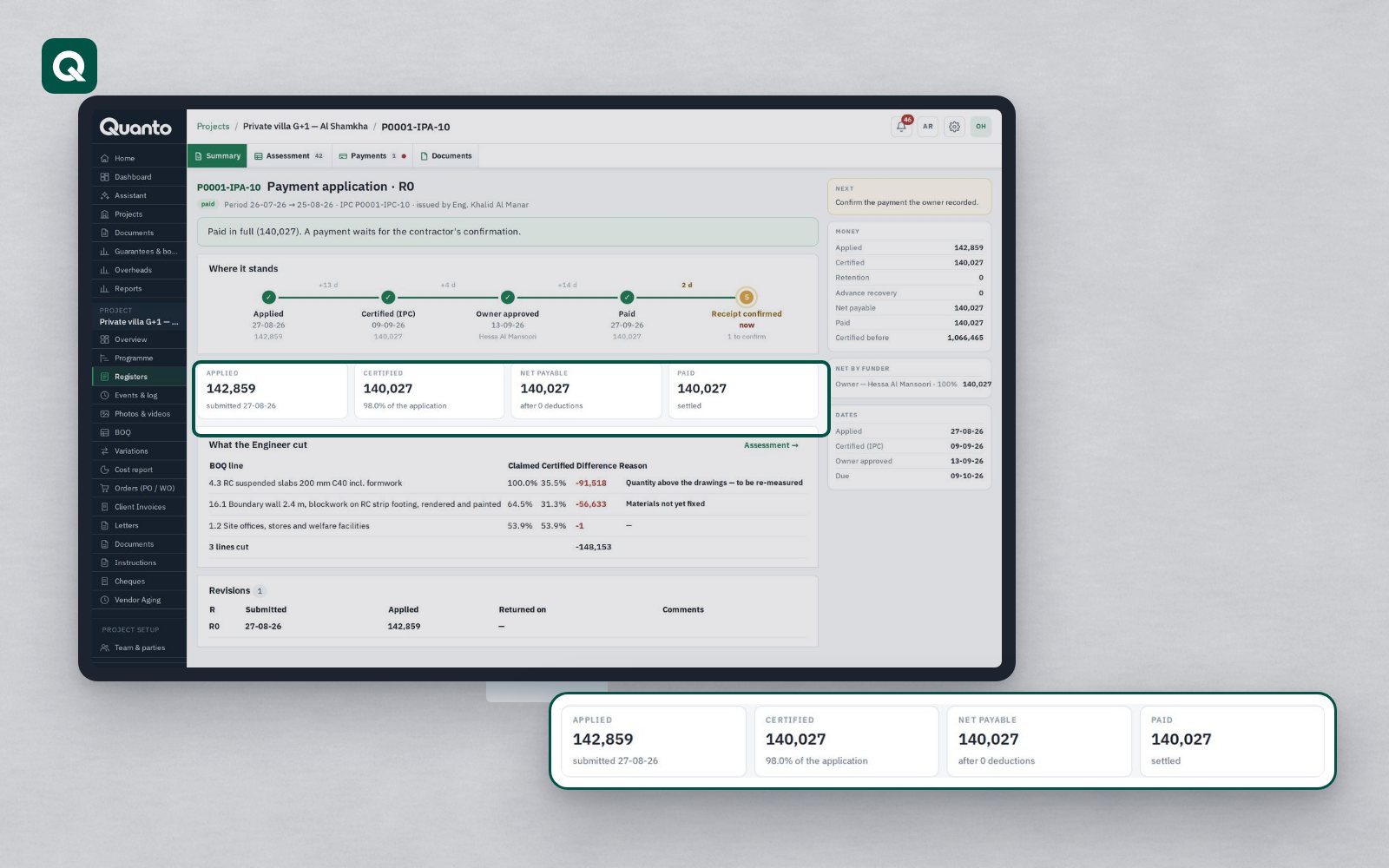
Taking-over is close. The owner's finance team reconciles the payments and finds that part of the advance payment was never recovered. The deduction stopped in one certificate after a revision of the payment sheet, and nobody noticed. The contractor's commercial manager disagrees with the figure. The Engineer's quantity surveyor rebuilds eighteen certificates from PDFs to find out who is right. Meanwhile the advance payment guarantee is about to expire.
What it costs
For the owner, an advance not fully recovered is money paid for work that was never done. For the contractor, an unexpected balance at the end of the job is a cash shock, often at the moment when retention, the final account and the last subcontractor payments are all in play. For both sides, the argument delays the final certificate and the release of the guarantee.
Many contracts recover the advance by a deduction from each interim certificate. Under the FIDIC 2017 Red Book (Sub-Clause 14.2.3), any part still outstanding becomes due in full before the Taking-Over Certificate is issued or on termination. Your own Particular Conditions set the rate, the start point and the guarantee.
An advance of AED 4,000,000 is to be recovered by deducting 20% of each certified amount. In certificate 9 the deduction is left out after a revision. Certificate 9 certified AED 1,500,000, so AED 300,000 was not recovered. The gap surfaces only at the end, and both sides spend weeks agreeing a figure that one line in each certificate could have shown.
How it is usually handled
The payment certificate is an Excel workbook copied forward each month. The advance recovery is a formula on one sheet, and the cumulative balance is a number someone types. When the template is changed, a link breaks, or a row is deleted, the deduction quietly stops. The previous certificates are PDFs that cannot be checked without retyping them.
The guarantee sits in a drawer, and its expiry date sits in someone's diary, if anywhere.
How Quanto Management handles it
In Quanto Management, the advance is part of the contract record, and its recovery is part of every certificate (Professional and above).
- The main contract holds the contract sum, retention, the advance payment and its recovery, delay damages and their cap, the defects liability period and key dates.
- Progress is entered by BOQ line for each valuation period, and the payment application builds itself from it.
- Each application carries retention, advance recovery, materials on site, amounts held for open NCRs, unapproved variations on account and credits.
- The Engineer certifies line by line, with reasons for any amount held; the owner approves where the contract requires it.
- Guarantees and bonds carry expiry alerts, so the advance payment guarantee does not lapse unseen.
- Owner payments are recorded and confirmed, and cash flow shows money in and out by month.
Advance recovery is a line of its own on every application, so a missing deduction shows in the certificate rather than hiding in a broken formula. Records are never silently deleted, and changes are logged with who and when.
A short checklist
- Read the advance clause in your contract: the rate, when recovery starts and what happens to any balance.
- Show the advance recovered to date and the balance on every certificate, not only this month's deduction.
- Reconcile the cumulative recovery against the advance paid each quarter.
- Check that the guarantee stays valid until the advance is fully repaid.
- When the payment template changes, check the deduction lines in the first certificate after the change.
Tomorrow: the RFI nobody answered.
General information only. Periods and procedures depend on the form of contract and its particular conditions; always check your own contract.
Follow Quanto for a new article every day: LinkedIn · X · YouTube · Instagram · Facebook