
Level 3 slab. The steel fixer finds that the beam reinforcement on the structural drawing clashes with a sleeve on the MEP drawing. The site engineer writes an RFI on Sunday morning and emails it to the consultant. By Wednesday there is no answer. The following Sunday, still nothing: the structural engineer who should reply is on leave. The pour is held, the formwork stays where it is, and the gang moves to whatever else it can find.
Three months later, in the extension-of-time discussion, the consultant asks a simple question: when exactly was this raised, and why was it not chased?
What it costs
An unanswered RFI is rarely one lost day. It holds an activity, that activity holds the next one, and the lost time only becomes visible when someone compares the programme with what actually happened. By then the evidence is thin: an email in someone's sent folder, a reminder made by phone, a diary note that may or may not quote the RFI number.
Without a clear record of when the question was asked, when the answer was due and when it actually came, the delay is hard to claim, and the cost of the waiting crew and plant is hard to recover.
An RFI on a slab is answered 12 days late. The pour waits, with formwork, a steel fixing gang and a pump booking costing AED 18,000 a day. That is AED 216,000 of time-related cost before any knock-on effect on the trades that follow. If the RFI dates cannot be shown, much of it may stay with the contractor.
How it is usually handled
Most RFIs live in a spreadsheet kept by the document controller, with copies sent by email. Some questions are asked on WhatsApp and never become RFIs at all. The spreadsheet shows a list, but not who is holding each item today, and nobody is reminded when an answer is overdue. The consultant keeps its own list, which rarely matches. When a dispute comes, both sides rebuild the history from their inboxes.
The real problem is not the format. An RFI with no due date and no owner is nobody's job.
How Quanto Management handles it
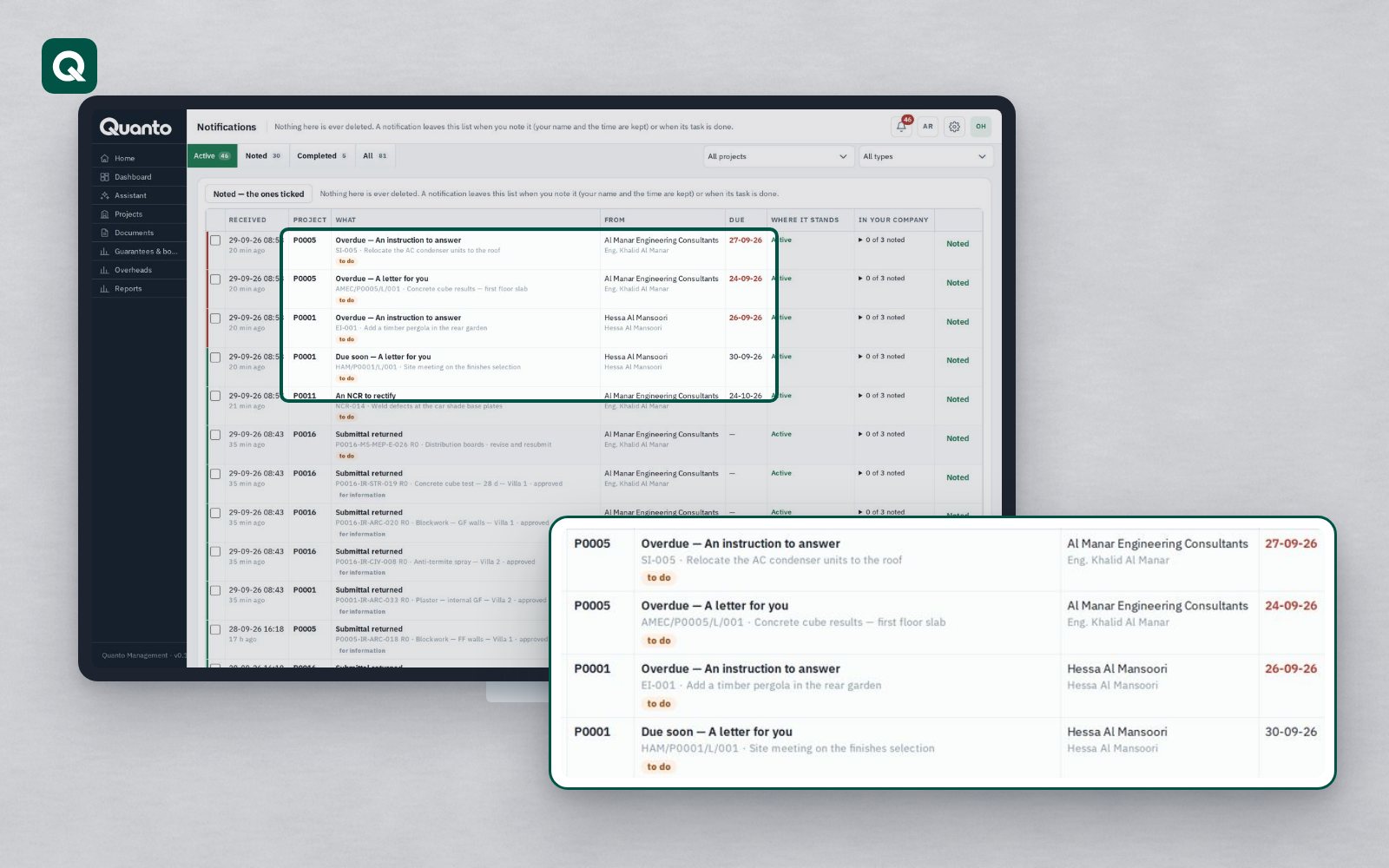
In Quanto Management, RFIs sit in the project registers alongside submittals, inspection requests, transmittals, NCRs and instructions, each with its due date. The contractor and the consultant work on the same project, so there is one register, not two.
- Each RFI records its cost and time impact, so a question that is holding work is visible as such.
- Open items appear on the "waiting on you" list of the party that has to act.
- Reminders arrive two days before the due date and again when it is missed, and a morning email summary lists what is outstanding.
- The project log records every action automatically, so the history of each RFI is never rebuilt from memory.
When a late answer does cause a delay, the record is already there. The stoppage can be recorded as a site event with the hours lost and its impact, and a claim can link those site events, photos and letters as its evidence. On Business and above, time impact analysis with fragnets on the programme shows the effect on the completion date.
A short checklist
- Give every RFI a number, a date sent and a date the answer is needed, even if the contract sets no period.
- Write on the RFI which activity it is holding, and from when.
- Turn questions asked by phone or message into a numbered RFI the same day.
- Review open RFIs at every progress meeting and minute the reply dates promised.
- When an answer is late and work stops, record the stoppage in the daily record that day, quoting the RFI number.
Tomorrow: the letter without a reference.
Follow Quanto for a new article every day: LinkedIn · X · YouTube · Instagram · Facebook