
Month nine. The project is eleven weeks late and the contractor's planner is asked to prepare the extension-of-time claim. Everyone remembers what happened: the late access to the podium, the drawings that came back three times, the two weeks of authority inspections. The planner opens the files. The daily reports stop in month four. The site photos are on three phones. The letters are in someone's sent folder. The claim has a story but no proof.
What it costs
An extension of time does two things. It protects the contractor from delay damages for the period granted, and it opens the door to the time-related costs of the delay. Without records, the Engineer can only assess what is shown. A delay that cannot be shown is often a delay that is not granted, and the contractor carries both the damages and the extra site costs.
A contract with delay damages of AED 20,000 per day and site overheads of AED 15,000 per day. The contractor claims 60 days but can prove only 25. The 35 unproven days are worth up to AED 700,000 in delay damages, plus AED 525,000 of overheads that cannot be recovered.
Under the FIDIC 2017 Red Book, the Notice of Claim is due within 28 days (Sub-Clause 20.2.1) and the fully detailed claim within 84 days (Sub-Clause 20.2.4), and the contractor is expected to keep contemporary records (Sub-Clause 20.2.3). Records made at the time carry far more weight than records rebuilt months later.
How it is usually handled
Daily reports are written on paper or in Excel, when someone has time. They record manpower but not what stopped the work. Delays are discussed on WhatsApp and in meetings, and decided by phone. Photos are taken but never labelled. The programme is updated, but the baseline used for the analysis is a different version from the one submitted.
When the claim is finally written, the team spends weeks reconstructing events from emails and memories. The Engineer then asks the obvious question: where is the record from that day?
How Quanto Management handles it
In Quanto Management, the evidence is collected as the project runs, not when the claim is written.
- Site events in 14 types, including weather, delays, instructions, inspections and deliveries, are recorded with hours lost and impact.
- The daily site report includes the subcontractors' manpower and plant; the contractor confirms their rows, and the signed day is frozen and acknowledged by the Engineer.
- Photos and videos are tagged by area and linked to events, activities, BOQ lines, variations and letters.
- Letters carry time-stamped receipt, reply-by dates and threads.
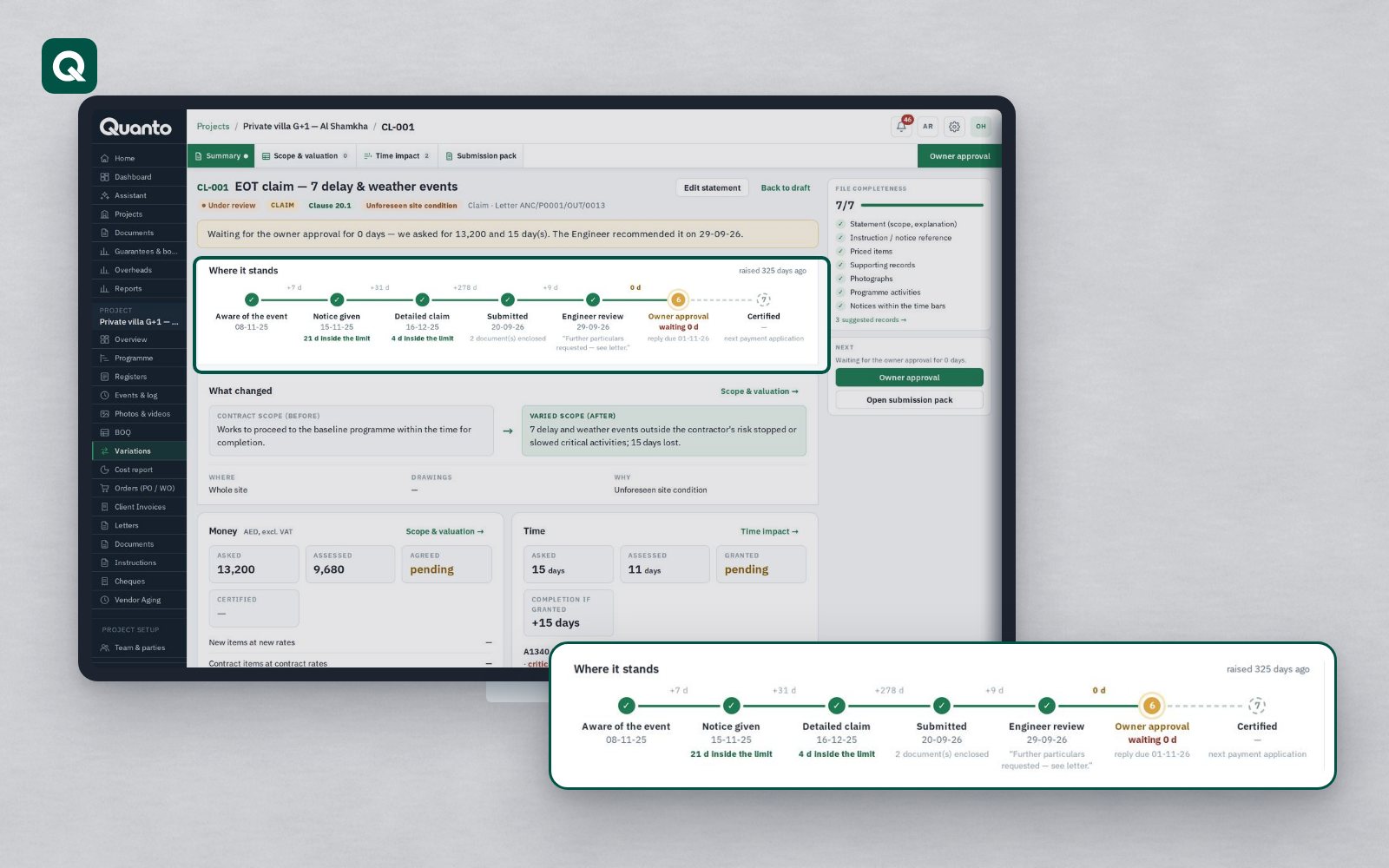
- Claims carry the extension of time with linked site events, photos and letters as evidence; continuing claims take interim updates.
- The programme is imported from Primavera P6 or MS Project with its baseline and updates. On Business and above, time impact analysis with fragnets and prolongation cost by head, including the Emden formula.
The claim notice period of your form of contract is counted on the project calendar, with reminders before it runs out. Records are never silently deleted: changes are logged with who and when.
A short checklist
- Record every delay event on the day it happens: what, where, which activity, how many hours lost.
- Get the daily report signed by the Engineer's representative while the day is still fresh.
- Link each photo to the event and area it shows, not just a date folder.
- Send the notice first and the detail later; do not wait for the full picture.
- Keep the accepted baseline programme and every update you submitted.
- Write down the effect on the programme as it happens, not at the end.
Tomorrow: the snag list that never closes.
General information only. Periods and procedures depend on the form of contract and its particular conditions; always check your own contract.
Follow Quanto for a new article every day: LinkedIn · X · YouTube · Instagram · Facebook