
Three weeks before the planned handover, the Engineer and the owner's team walk the building. They come back with a snag list of four hundred items: chipped paint, a missing door stopper, a loose socket, a scratched glass panel. The list is typed into Excel and sent to the contractor. A month later the contractor says 350 are done. The owner's team walks again and finds 120 still open, plus 60 new ones. Nobody agrees which list is the real one.
What it costs
Each snag is small. Together they hold up taking-over. While the building is not taken over, the contractor keeps paying for security, cleaning, site staff and insurance, and may be exposed to delay damages. The owner cannot move tenants in. Part of the retention usually waits for the same milestone. A snag list that drifts for two months costs both sides far more than the snags themselves.
A residential building with site running costs of AED 8,000 per day after the planned completion date. The snag list takes 45 days longer than planned to close. That is AED 360,000 in running costs, before any delay damages, for items that were mostly a few hours' work each.
How it is usually handled
The snag list is a spreadsheet, or several. The consultant has one version, the contractor another, each subcontractor gets the rows for their trade by email and replies with "done" on WhatsApp. Photos of the fix, if any, sit on a supervisor's phone. Nobody records who verified what, or when.
When the owner's team returns, they have no way of knowing which items were really fixed and which were simply marked done. So they walk everything again, the list grows, and trust between the parties falls.
How Quanto Management handles it
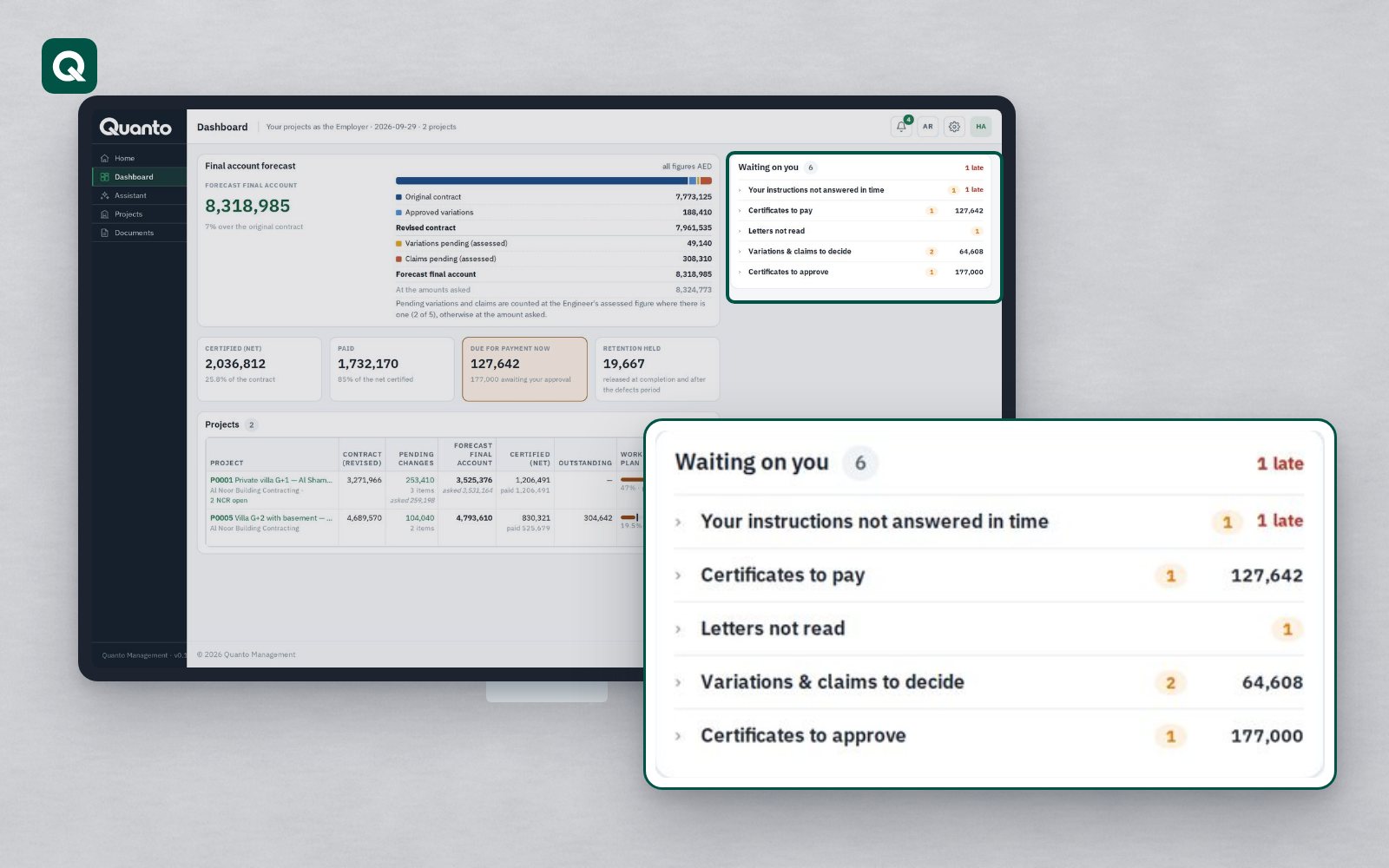
In Quanto Management, each party works from the same project, and each has its own home page with a "waiting on you" list. The snag list stops being a file passed around and becomes a set of items with owners.
- Snags for each trade go straight to the subcontractor responsible, who joins the project free.
- The subcontractor marks a snag fixed with a photo and a note and sends it for verification.
- The Engineer verifies and closes it, so "done" means checked, not just claimed.
- The photo of the fix stays with the snag, so the evidence is where the question will be asked.
- NCRs follow the same path to close-out, with rectification, re-inspection and verification, and the owner receives a copy of every NCR.
Quanto works in the phone's browser in Arabic and English, so a foreman can close snags on the floor rather than at the end of the day. The contract record keeps the defects liability period, so what remains open after taking-over still has a date attached.
A short checklist
- Give every snag a location, a trade and one person responsible.
- Do not accept "done" without a photo of the fix.
- Agree with the Engineer who verifies, and how quickly, before the first walk.
- Walk the building by area and trade, not as one big tour.
- Keep one list only; send links to it, never copies.
- Close easy snags first, so the open count falls and the hard items get the attention.
Tomorrow: an order placed without a budget.
Follow Quanto for a new article every day: LinkedIn · X · YouTube · Instagram · Facebook