
Half past ten on a Tuesday. A scaffold board slips on the third floor, and a labourer from the blockwork subcontractor cuts his hand badly on the way down. The foreman drives him to the clinic. The safety officer takes two photos on his phone and makes a note to write it up later. By the afternoon there is a concrete pour, an inspection and a delivery to deal with. The report is written three days later, from memory, and the subcontractor's version is different.
What a late report costs
An incident report written days later is weak in every way that matters. Witnesses have moved to other work or left the site. The scaffold has been repaired, so nobody can show what it looked like. The time lost that day is never recorded against the incident, so it cannot be explained later. And when the Engineer asks for the report, the main contractor has to chase the subcontractor for facts it should already have.
There is also the cost of repetition. If the root cause is never written down, the same board slips again next month, on another floor.
An incident stops a scaffolding gang of six for four hours while the area is made safe. At AED 30 per man-hour, that is AED 720 of lost time, before any medical cost, any stop on the floor below or any knock-on delay. Without a dated record of the stop, none of it can be explained or recovered later.
How it is usually handled
Most sites still run incident reporting on paper and phones. A form in a drawer in the site office. Photos in a group chat, between two hundred other messages. A spreadsheet log updated by the safety officer at the end of the week. The subcontractor's report arrives by email as a scanned sheet, if it arrives at all.
Each of these holds part of the story, and none of them is linked to the others. The photos are not tied to the report, the report is not tied to the day's site record, and the corrective action is agreed in a meeting and then forgotten.
How Quanto Management handles it
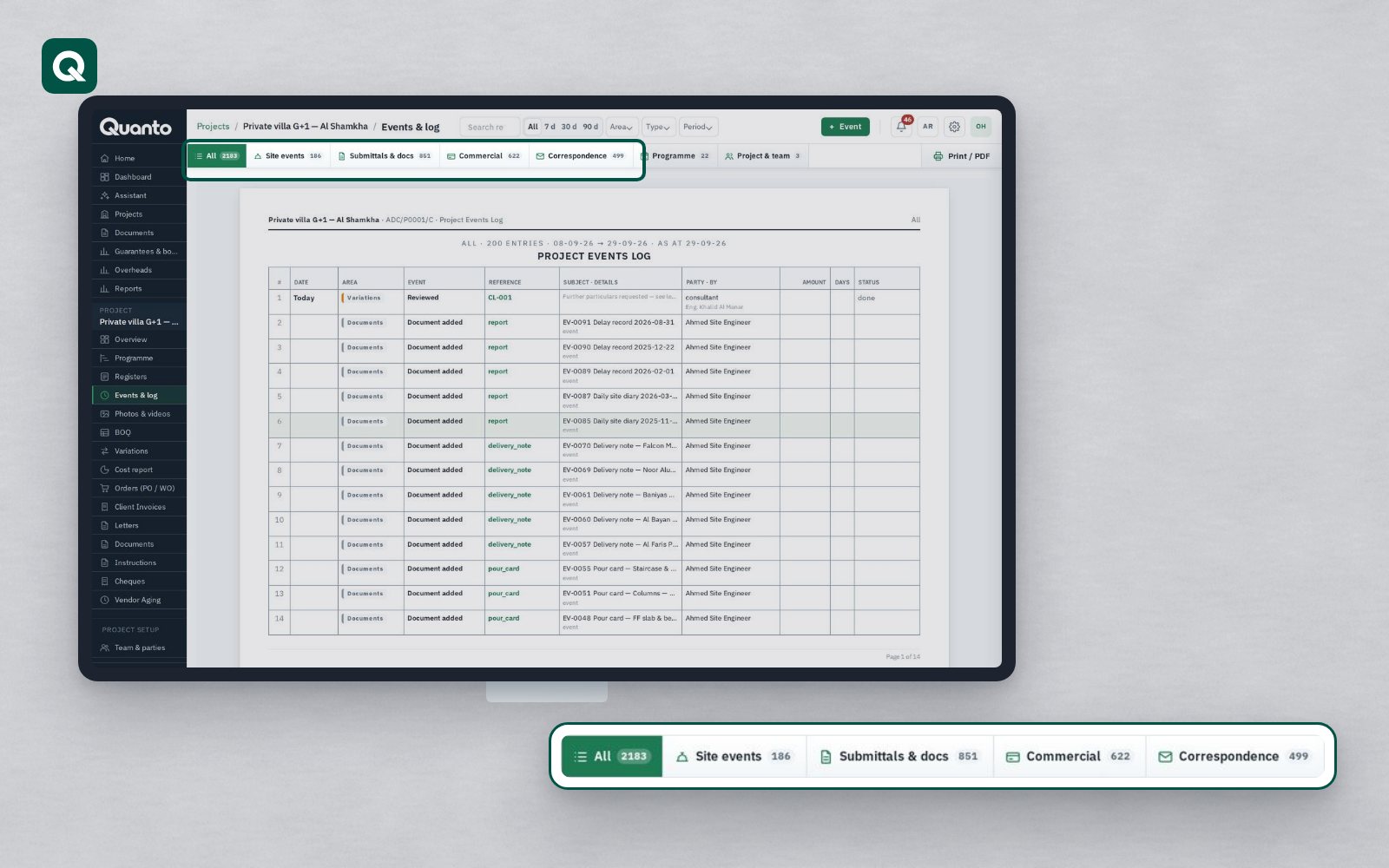
In Quanto Management an incident is one of the 14 types of site event. It is recorded on the day, with the hours lost and its impact, next to the meetings, pours, deliveries and inspections of the same day. Quanto works in the phone's browser, so the record can be started where it happened, not back at the office.
- Invited subcontractors report incidents on the standard A4 incident sheet (FIDIC 2017 4.8 / 6.7): the event, the people involved, the injury, the immediate action, the investigation and the root cause, in one record, filled in on the phone.
- The main contractor reviews the report and reports it to the Engineer.
- Photos and videos are tagged by area and linked to the event, so the evidence sits with the report.
- Incident reports keep their full history, as an ISO 45001 system needs, and records are never silently deleted.
- The project log records every action automatically, so it is clear who reported what, and when.
Every screen is in Arabic and English, and each user chooses the language. A foreman who writes in Arabic and a safety manager who reads in English work on the same record.
A short checklist
- Start the report on the day, at the place, even if the investigation comes later.
- Take photos before anything is moved or repaired, and note the area.
- Record the hours lost and the work affected, not only the injury.
- Write down the immediate action, and name the person responsible for the corrective action, with a date.
- Make sure the subcontractor's report and yours describe the same event, and keep one record.
- Review open corrective actions at every safety meeting until each one is closed.
Tomorrow: material rejected after delivery.
Follow Quanto for a new article every day: LinkedIn · X · YouTube · Instagram · Facebook