
Two lorries of porcelain floor tiles arrive on a Sunday morning. The storekeeper counts the pallets against the delivery note and signs. On Monday the consultant's inspector opens a box and stops the work. The tile is 9 mm, not the 10 mm in the approved submittal. The approval was "approved as noted", revision B, and the note about thickness never reached the person who placed the order. The order had been written from the supplier's first quotation.
What it costs
A rejected delivery is never just a return. The finishing gang waits or is moved to work it was not planned for. The supplier argues that it delivered exactly what was ordered, and on paper it is right. The replacement has a lead time. Storage on a tight site is lost to pallets nobody can use. And if the rejection is not written down properly, the invoice for the wrong material may still be paid.
1,800 m² of tiles at AED 85 per m² is AED 153,000 of material that cannot be fixed. The replacement takes six weeks. If tiling is on the critical path, those six weeks reach the completion date, and the cost of a wrongly worded order is now much larger than the tiles.
How it is usually handled
The approved submittal is a PDF attached to an email from the consultant, with comments in a stamp in the corner. The procurement team works from quotations in another folder. The store checks quantities against the delivery note, because that is the paper it has. When the inspector rejects the material, the message goes out by phone and a group chat, and nobody raises a formal record.
The problem is not carelessness. The approval, the order and the delivery live in three different places, held by three different people, and nothing connects them.
How Quanto Management handles it
In Quanto Management the submittal, the order and the site record sit in the same project.
- Material submittals carry their revisions and review codes (A–D), ball in court and due dates, so everyone sees which revision was approved and with what comments.
- Approved materials are kept with their certificates.
- Purchase orders (Professional and above) need a vendor quotation attached before they can be issued, carry their payment and warranty terms, and are booked against a cost code.
- Deliveries are recorded as site events, with photos tagged by area and linked to the event.
- A rejection becomes a non-conformance report followed from raising to close-out: response, rectification, re-inspection and verification, with root cause and corrective action.
- Vendor invoices are recorded with their due dates, and payments are released after approval.
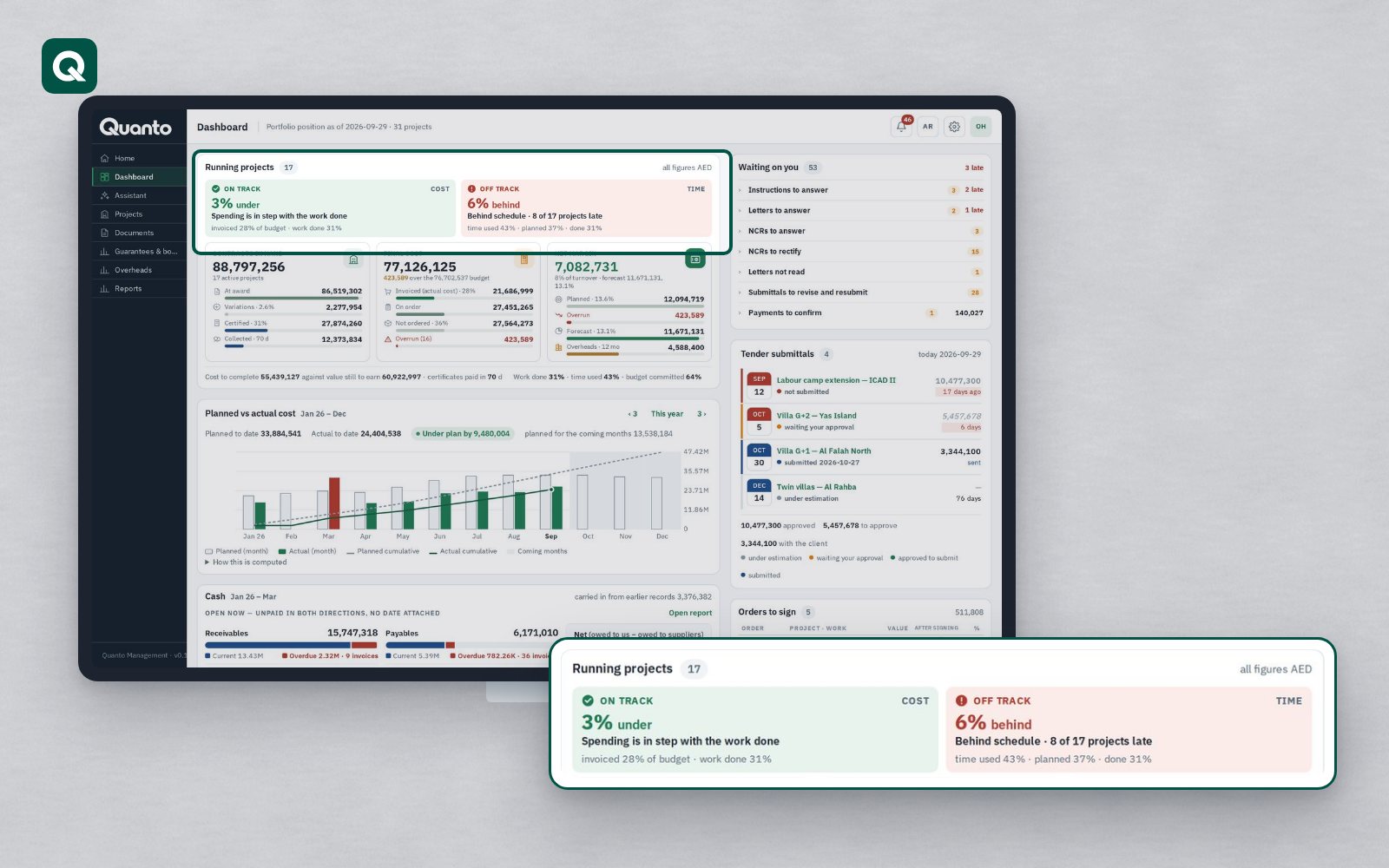
The company dashboard shows the approvals waiting across every running project, so a submittal sitting with the consultant is visible before the order deadline, not after the lorry arrives.
A short checklist
- Write the order from the approved submittal and its comments, not from the first quotation.
- Put the approved make, reference and key dimensions on the order itself.
- Give the storekeeper the approved submittal, not only the delivery note.
- Photograph labels and batch numbers on arrival, before anything is unloaded into the building.
- Record any rejection in writing on the same day, with photos.
- Hold the supplier's payment for rejected material until the replacement is accepted.
Tomorrow: meeting decisions that never get followed up.
Follow Quanto for a new article every day: LinkedIn · X · YouTube · Instagram · Facebook