
A bundle of rebar slips from the sling at level 6 and lands a metre from two labourers on the ground. Nobody is hurt. The banksman shouts, the crane operator stops, the supervisor checks everyone is fine, and after twenty minutes work carries on. By the evening it is a story told in the site office. It is not in any report.
Three weeks later: the same crane, the same kind of lift, another sling. This time a man is injured.
What it costs
A near miss is a free warning. The causes of the near miss and of the later injury are usually the same: the lifting method, the slings, the exclusion zone, the supervision. Recorded and investigated, the near miss fixes them for the price of a toolbox talk. Ignored, the same causes turn up in the investigation of the injury, together with a question nobody wants to answer: did you know?
After a serious incident come the investigation, the stopped work, the visit from the authority and the insurer's questions. Each costs far more than the time it would have taken to write the near miss down.
The tower crane is stopped for three days after a lifting injury, and the trades that depend on it stand. On a mid-size site that is AED 40,000 a day in idle labour, plant and overheads: AED 120,000 before any medical, legal or insurance cost. Recording the near miss three weeks earlier would have taken an hour.
How it is usually handled
- Near misses are reported to the safety officer by word of mouth, if at all.
- The incident register is an Excel file in the HSE office, filled in when someone is hurt.
- Photos of the scene stay on the supervisor's phone.
- Subcontractor staff do not report to the main contractor, for fear of being blamed.
- The monthly safety report counts injuries, while the near misses that should shape it are missing.
How Quanto Management handles it
Quanto works in the browser on phones and tablets, so the record is made on site, at the time, by the person who saw it.
- Incidents are one of the 14 types of site event, recorded with their date and impact, whether or not anyone was hurt.
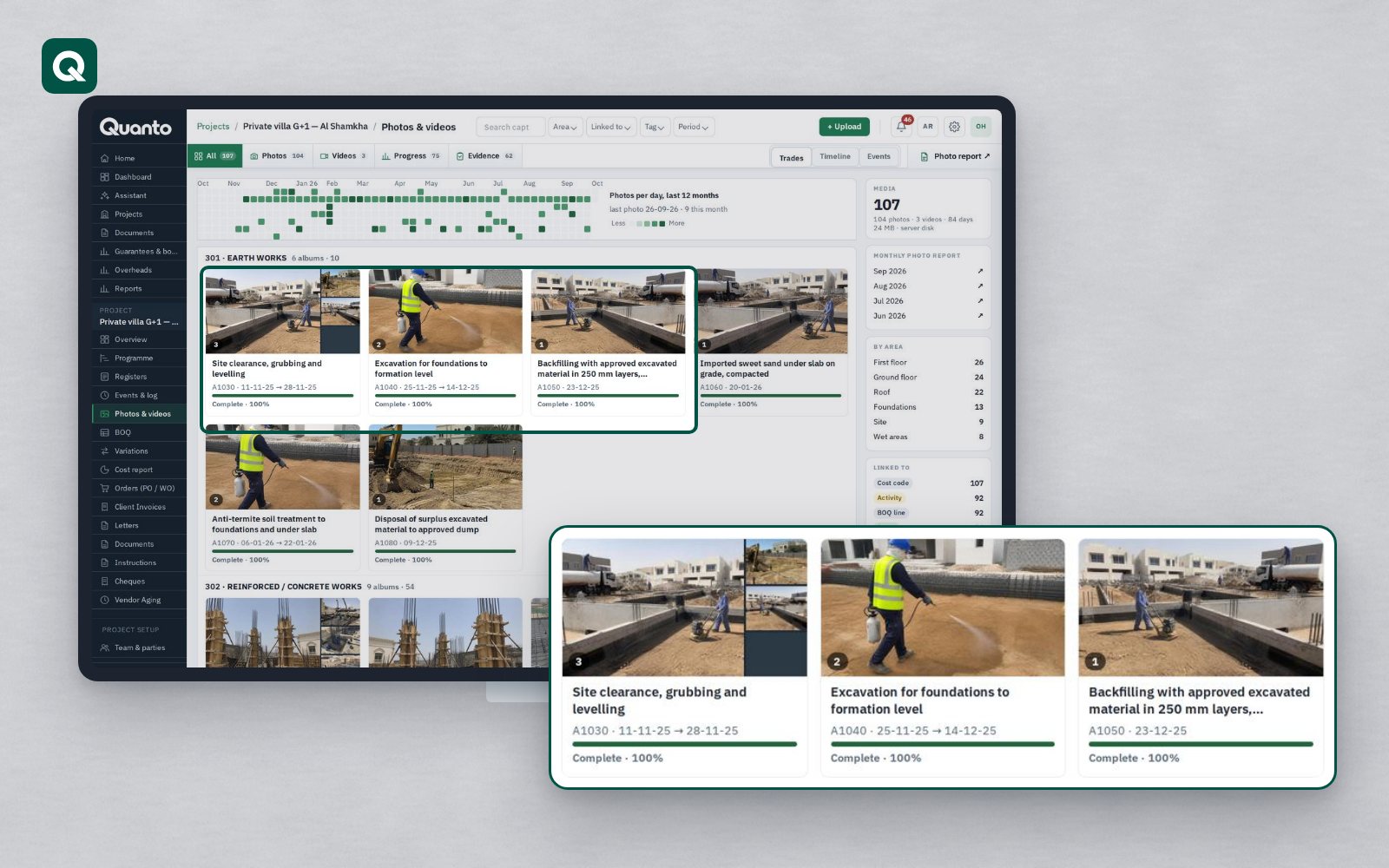
- Photos and videos of the scene are tagged by area and linked to the event.
- Incident reports follow the standard A4 incident sheet: the event, the people involved, the immediate action and the investigation, with root cause and actions in one record.
- Invited subcontractors can report incidents from site on the same sheet, for the main contractor to review and report to the Engineer.
- The project log records every action automatically, and records are never silently deleted, so a report cannot quietly disappear.
Kept with their history next to the project's other quality and safety records, incident reports help keep those records in line with ISO 45001. The certification itself is done by your certification body.
A short checklist
- Agree with every supervisor what counts as a near miss, using three or four examples from your own site.
- Record each near miss the same day, with a photo of the scene.
- Thank the person who reported it, in front of others. Blame stops reporting.
- Look for the same cause appearing twice, and fix it before the third time.
- Count subcontractors' near misses with your own.
- Close each one with an action and a name.
Tomorrow: a variation done but never priced.
Follow Quanto for a new article every day: LinkedIn · X · YouTube · Instagram · Facebook