
In month four, an instruction from the Engineer changes the lobby ceiling from gypsum board to a metal baffle system. The contractor acknowledges it, orders the new system and builds it. The ceiling is finished in month seven and looks good. In month eighteen, preparing the final account, the quantity surveyor finds the instruction in the letters file. There is no priced variation. There are no measured quantities, no record of the gypsum board already delivered, and the site engineer who managed the work has moved to another project.
The work is done. The question now is whether it will ever be paid.
What it costs
An unpriced variation is cost without income. The longer it waits, the weaker it gets: the work is covered, the people have left, the quotations have expired, and the owner's team asks why it is hearing the amount for the first time at the end. Some contracts also set a period for the contractor's proposal or notice, and a late submission can be argued as out of time.
While it waits, it also distorts the project's picture. The cost is in the books and the income is not. The project looks worse than it is until the final account, where the variation is argued at a discount.
The baffle ceiling costs AED 310,000 against AED 140,000 for the gypsum board in the BOQ. The variation is worth AED 170,000, plus the board already delivered and no longer needed. Submitted in month seven with quantities, invoices and photos, it is a routine approval. Submitted in month eighteen from memory, it is a negotiation, and the contractor may settle for half.
How it is usually handled
- Instructions are logged in a letters register, but nobody checks that each one has a variation behind it.
- Variations are priced in Excel when the quantity surveyor has time, which is after the monthly payment application.
- Records of the changed work are mixed in with the rest of the daily reports.
- The variation register shows what was submitted, not what was instructed and never submitted.
The gap is not in the pricing. It is between the instruction and the start of the pricing, where nothing forces the next step.
How Quanto Management handles it
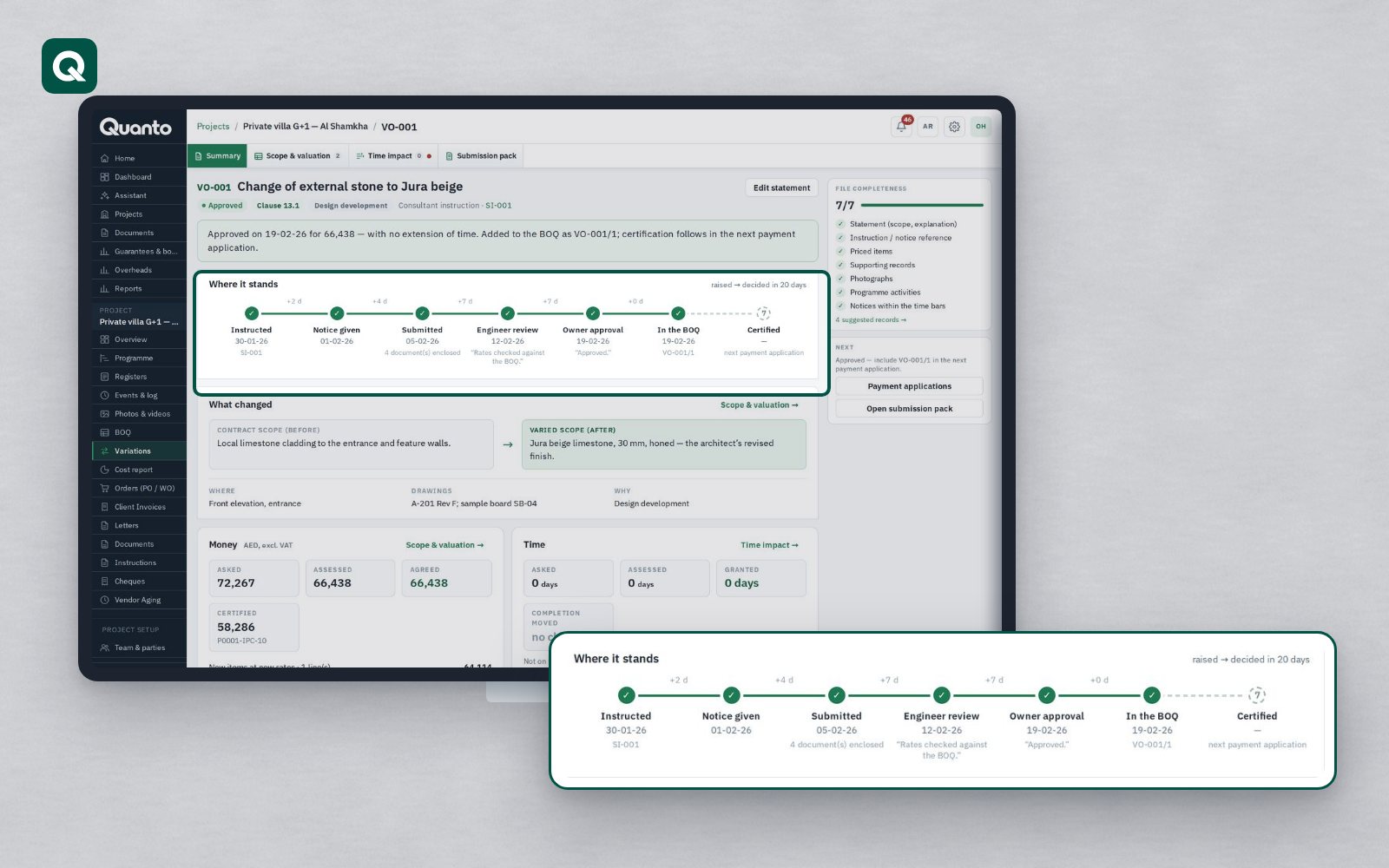
In Quanto, an instruction from the Engineer or the owner is not filed and forgotten. The contractor must answer it as no cost, variation or disputed, so an instruction without an answer stays in view.
- Variations are priced by item, submitted by the contractor, reviewed by the consultant and approved by the owner, with every step dated and named.
- Photos and site events are linked to the variation they belong to, so the evidence is collected while the work is being done.
- Unapproved variations on account are one of the items each payment certificate works out (Professional and above), so a variation under review is not invisible in the monthly cycle.
- The revised contract sum is always the original plus approved variations, with a watch on variations as a share of the contract sum.
- Reminders arrive two days before a deadline and when it is missed, with a morning email summary.
The quantity surveyor sees the instruction, the work, the photos and the price in one file, while the people who did the work are still on site.
A short checklist
- Every month, match each instruction received against a variation or a "no cost" reply.
- Price the variation before the work is covered, even if the first price is an estimate.
- Photograph the changed work and the work it replaced, with dates.
- Record any materials made redundant by the change, and where they are stored.
- Check your contract for any period for submitting a variation proposal or notice.
- Leave no variation for the final account.
Tomorrow: the same NCR again and again.
Follow Quanto for a new article every day: LinkedIn · X · YouTube · Instagram · Facebook